
P. Licinius Valerianus
Dynasty: Family of Valerian
Augustus (AD 253-260)Publius Licinius Valerianus was from a noble senatorial family and a senior member of the senate during the reigns of Maximinus through to Decius (Zos 1.14; HA, Gordian, 9.7-8; Zon 12.20). He was commander of the Rhine legions during the reign of Gallus and, on Aemilian's rebellion, was called for to march south to aid Gallus. In AD 253, Valerian arrived to discover that the army had deserted Gallus for Aemilian but in the subsequent battle, the soldiers deserted Aemilian for Valerian (Zos 1.29; Victor 32; Eutr 9.7; Zon 12.22). On becoming emperor, Valerian immediately appointed his adult son Gallienus co-Augustus (Zos 1.30; Victor 32; Eutr 9.7; Zon 12.23) and, soon afterwards, Gallienus' oldest son, Valerian II, was appointed Caesar. Valerian's wife (and Gallienus' mother) Mariniana had already died before her husband became emperor, but he deified her and issued coins in her name and image. He also ordered a systematic persecution of the Christians, similar to that of Decius (Zon 12.23). The Persians under Sapor, however, had taken advantage of Rome's instability, and had overrun many of the Eastern provinces, including capturing Antioch. Gallienus was left in charge of the West while Valerian marched East to battle the Persians (Zos 1.30). By AD 257, Antioch had been retaken, but the Goths had ravaged much of Asia Minor the following year (Zos 1.31-35). In 259 Valerian had moved to Edessa, where an outbreak of the plague killed many Roman soldiers (Zos 1.36), and the Persian besieged the town. In summer of 260 Valerian was tricked by the Persians and captured (Zos 1.36; Victor 32; Eutr 9.7; Zon 12.23) - the first Roman emperor to be captured by an enemy. This captured left the Roman Empire in a much more perilous state. As the news spread, several mutinies and revolts broke out - one of Valerian's generals attempted to proclaim his sons emperors, the commander in Gaul, Postumus, declared himself emperor, and the Roman ally Odenauthus of Palmyra become more powerful while Gallienus struggled to maintain control of the centre (Zos 1.38; Victor 33; Zon 12.24). Accounts differ in regards Valerian's eventual fate, though most claimed he died after a long captivity as an old man. Lactantius, in recording the sorry demise of the Christian Persecutors, describes in grisly details Valerian's captivity: "for Sapores, the king of the Persians, who had made him prisoner, whenever he chose to get into his carriage or to mount on horseback, commanded the Roman to stoop and present his back; then, setting his foot on the shoulders of Valerian, he said, with a smile of reproach,'This is true, and not what the Romans delineate on board or plaster.' Valerian lived for a considerable time under the well-merited insults of his conqueror; so that the Roman name remained long the scoff and derision of the barbarians: and this also was added to the severity of his punishment, that although he had an emperor for his son, he found no one to revenge his captivity and most abject and servile state; neither indeed was he ever demanded back. Afterward, when he had finished this shameful life under so great dishonour, he was flayed, and his skin, stripped from the flesh, was dyed with vermilion, and placed in the temple of the gods of the barbarians, that the remembrance of a triumph so signal might be perpetuated, and that this spectacle might always be exhibited to our ambassadors, as an admonition to the Romans, that, beholding the spoils of their captived emperor in a Persian temple, they should not place too great confidence in their own strength" (Lact. Mort. pers. 5)
For explanations of many of the abbreviations used in Roman imperial obverse legends, click here.
|
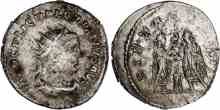
Valerian I Silver antoninianus issued AD 253 Obv: IMP C P LIC VALERIANVS AVG, Radiate, draped bust right Rev: PIETAS AVGG, Valerian and Gallienus, standing face to face, sacrificing at altar between them
Good Very Fine
|
AUD $160.00
|
|
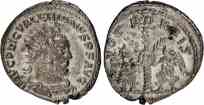
Valerian I Silver antoninianus issued AD 255/256 Obv: IMP C P LIC VALERIANVS PF AVG, Radiate, draped bust right Rev: VOTA ORBIS, Two Victories, winged, draped, affixing shield inscribed S C onto palm-tree
Nice Very Fine
|
AUD $150.00
|